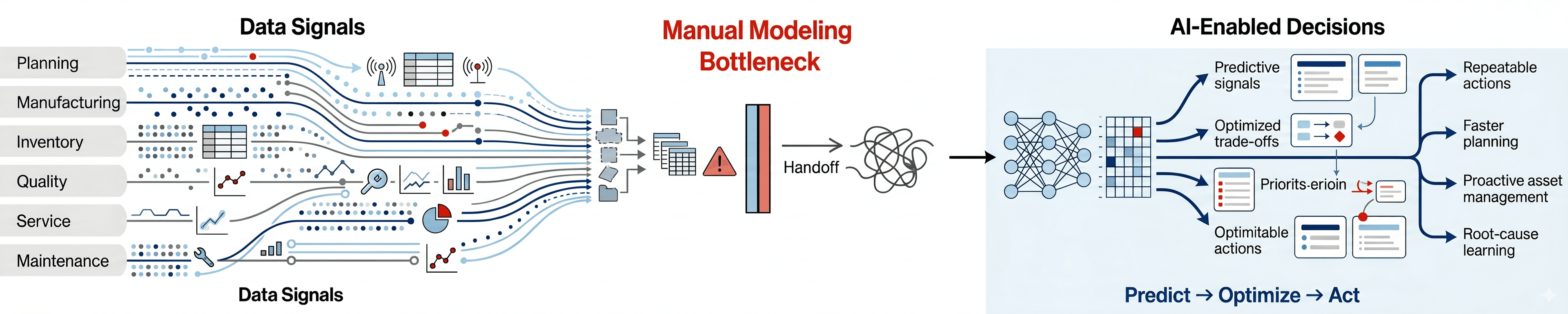
For CEOs & CMOs: Your team has the data. What they lack is a clear answer to one question: What should we do differently this quarter? This article explains the data-rich, insight-poor bottleneck—and how companies like Future Home Loans grew leads 180% while holding cost per lead flat.
Key takeaways
- The bottleneck is not more data—it's turning existing data into decisions your team can act on this week.
- Siloed tools and backward-looking dashboards keep marketing and sales optimizing different numbers.
- AI-assisted analysis surfaces funnel friction and attribution gaps faster than manual reporting cycles.
- Future Home Loans achieved +180% lead volume at the same CPL by prioritizing insight over instrumentation.
The problem in 60 seconds
Your CRM has thousands of contacts. Analytics tracks every click. Ad platforms report CPL and conversions. Your team exports spreadsheets every week.
And yet, when leadership asks "What should we do differently?"—the room goes quiet.
That gap is the data-rich, insight-poor bottleneck: plenty of metrics, not enough clarity on what to change, where to invest, or what to stop.
| State | What it looks like |
|---|---|
| Data rich | Analytics, CRM, ads, call tracking, and email—all generating signals |
| Insight poor | No confident answer on which channels drive revenue or what fix moves the needle most |
The bottleneck is not a technology problem. It is an interpretation and action problem.
What this costs your business
| Cost | Impact |
|---|---|
| Wasted ad spend | Budget flows to channels that look good in isolation but don't convert |
| Lost leads | Friction points stay hidden until competitors capture the opportunity |
| Slow decisions | Monthly reporting cycles while faster rivals test and adapt weekly |
| Team burnout | Analysts clean data; leadership still debates the same metrics |
| Flat growth | More tools and headcount, diminishing returns on marketing investment |
The irony: Companies increase data spend every year, yet many see diminishing returns because they add inputs without improving decision quality.
Four root causes
1. Siloed tools, fragmented truth
Google Analytics, your CRM, paid ads, and call tracking each tell a different story. Without a unified view, marketing celebrates traffic while sales questions lead quality—and nobody owns the full customer journey.
2. Reporting without decisions
Dashboards answer "What happened?" They rarely answer "So what?" or "Now what?" A 12% bounce rate does not tell you whether to fix page speed, rewrite copy, or retarget a segment.
3. Attribution gaps
When you cannot connect a lead to the touchpoints that created it, budget drifts to last-click channels. Awareness and nurture steps that actually drive conversions stay underfunded.
4. Manual analysis cannot keep pace
By the time a trend surfaces in a monthly deck, the window to act may have closed. Teams using AI-assisted analysis are reallocating budget while others are still building slides.
How Digital Optimus breaks the bottleneck
We do not sell more dashboards. We build systems that connect data to decisions—and decisions to revenue.
| Capability | Business outcome |
|---|---|
| Unified data pipelines | One view of the customer journey across analytics, CRM, and ads |
| AI-assisted pattern detection | Drop-offs, high-intent segments, and anomalies surfaced fast |
| Automated monitoring | Alerts when rankings slip, conversions dip, or competitors gain ground |
| Decision-first frameworks | Start with the business question; pull only data that answers it |
| Continuous optimization | Measure → interpret → act → validate—not a one-time audit |
Our principle: Start with the outcome—"How do we generate more qualified leads at the same cost?"—then build the smallest data stack that answers it.
Case study: Future Home Loans
Future Home Loans had traffic, tracking, and market positioning—but could not translate performance signals into consistent lead growth. Data lived in multiple systems; every optimization felt like a guess.
Challenge
Strong brand and content, but no clear link between website behavior, funnel friction, and lead outcomes.
Approach
Digital Optimus deployed an AI-informed analytics and optimization program:
- Funnel analysis — where high-intent visitors abandoned before converting
- Journey mapping — which paid, organic, and direct paths produced qualified leads
- Impact-ranked action plan — fixes prioritized by data, not opinion
- Continuous monitoring — improvements measured and compounded over time
One high-impact lever: page-speed optimization. Slow mobile load times caused abandonments before forms rendered—a pattern invisible in aggregate reports but obvious in journey-level data. See the full page speed case study.
Results
| Metric | Outcome |
|---|---|
| Lead volume | +180% |
| Cost per lead | Held flat — same CPL despite nearly triple the leads |
Bottom line: Future Home Loans did not need more data. They needed better insight—and the discipline to act on it.
What good looks like
Organizations that escape the bottleneck share four traits:
- Single source of truth — Marketing, sales, and leadership reference the same numbers
- Weekly decisions backed by data — Meetings end with owners and deadlines, not more questions
- AI surfaces signals; leaders approve action — Technology accelerates insight; people drive strategy
- ROI measured in leads and revenue — Not impressions, page views, or vanity metrics
If your team spends more time building reports than acting on them, you are still on the wrong side of the bottleneck.
The bottom line
The goal is not more data. It is better decisions, faster.
Companies that win connect their data, interpret it with AI-assisted precision, and turn insight into action before the opportunity passes. Digital Optimus helps small and mid-size businesses make that transition—with measurable outcomes in leads, CPL, and revenue.