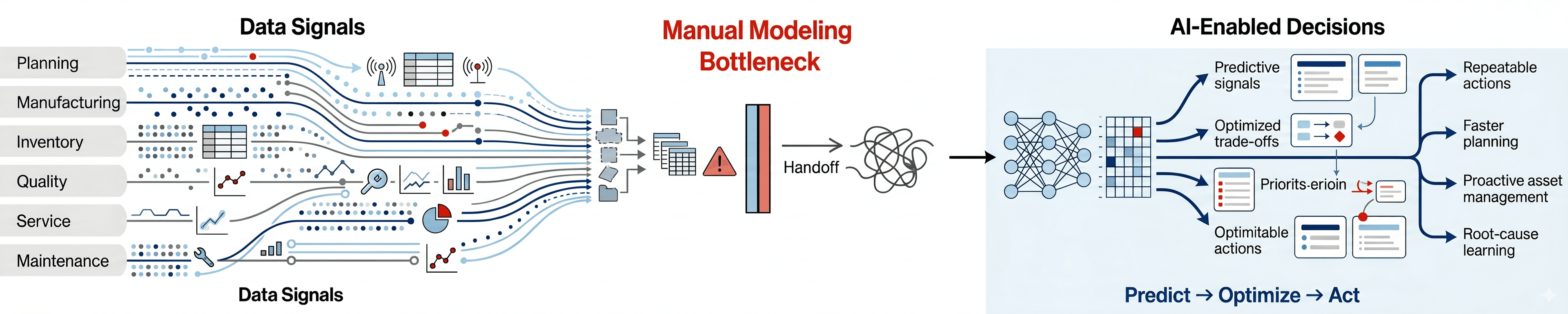
For CEOs & CMOs: AI has collapsed the cost of doing. Building the campaign, the tool, the automation—that part is faster and cheaper than it has ever been. What AI has not collapsed is the cost of doing the wrong thing. In a world where you can build almost anything, the winners are the ones who measure first and let the data decide what deserves to be built.
Key takeaways
- AI multiplies what's possible—which multiplies the number of ways to spend money badly. The filter has to get stronger, not weaker.
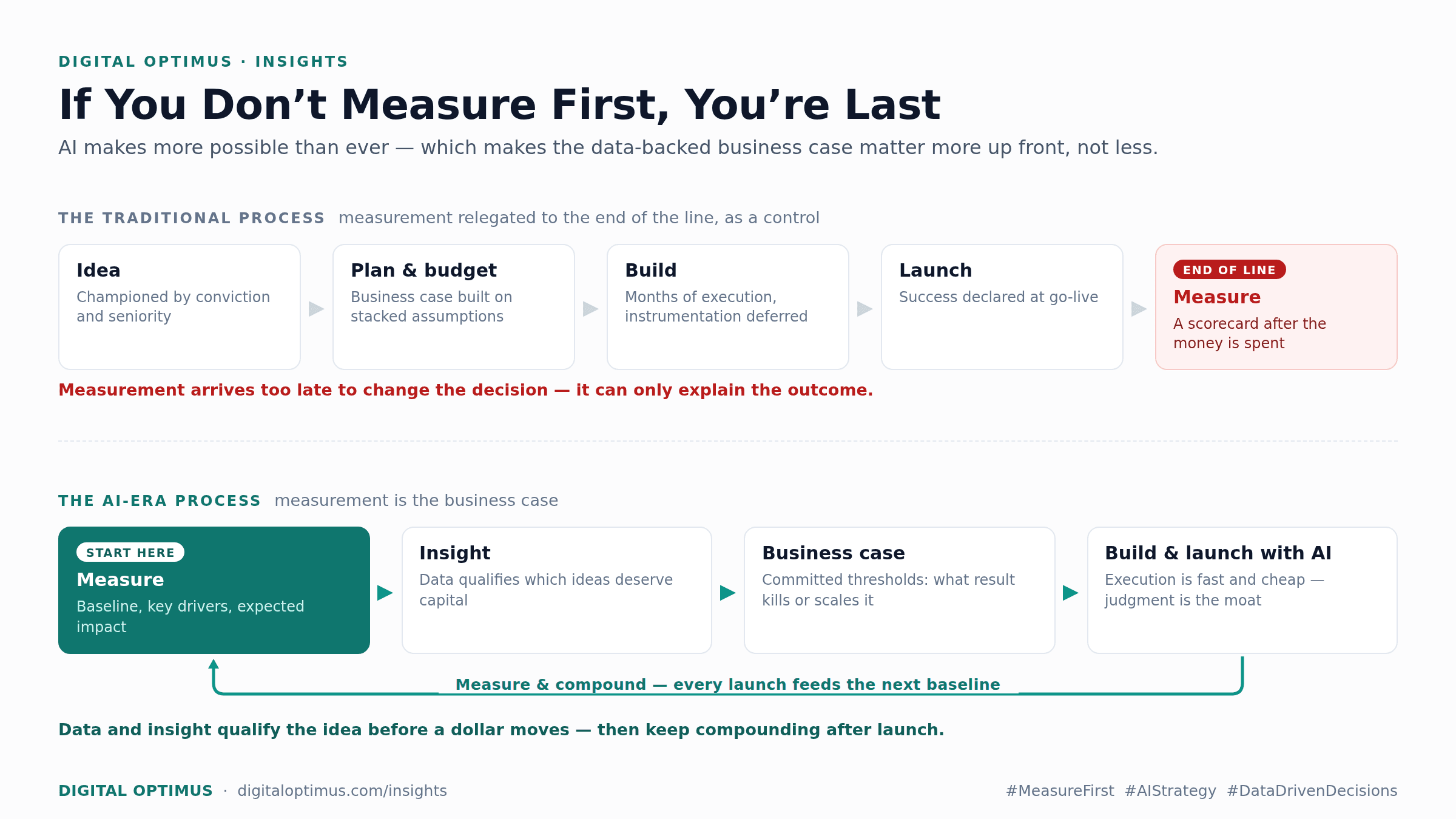
- The traditional process relegated measurement to the end of the line, as a control. By the time the numbers arrived, the decision was already sunk.
- A modern business case starts with strong data and keen insight on the front end: a baseline, the key drivers, and a pre-committed definition of success.
- Measure-first is a leadership discipline, not a tooling problem. The technology to do it has never been more accessible.
"If you ain't first, you're last"
Ricky Bobby's famous line was terrible racing advice and surprisingly good strategy advice—with one edit. In the AI era, it's not about being first to launch. It's about being first to know: first to know your baseline, first to know which lever actually moves revenue, first to know whether an idea deserves capital at all.
Because here's the uncomfortable math of this moment: when everyone can execute quickly, execution stops being the differentiator. Judgment does. And judgment without measurement is just confidence with better posture.
If you don't measure first, you're last.
The old assembly line: measurement as a control
Think about how the traditional corporate process actually worked. It was built like a factory line:
- Someone senior championed an idea.
- A business case was assembled—usually a stack of assumptions dressed up in a spreadsheet.
- Budget was approved, teams built for months, and the thing launched.
- And then—at the very end of the line—came measurement.
Measurement was quality control. It was the variance report, the post-mortem, the quarterly readout. It existed to explain what happened, not to decide what should happen. Analytics teams were positioned as scorekeepers, not navigators.
The problem is obvious once you say it out loud: a control at the end of the line can't save a decision made at the beginning of it. By the time the numbers showed up, the money was spent, the org chart had moved on, and the most honest possible finding—"this didn't work"—had no constituency.
A question I kept asking
I've never thought of myself as a measurement guy. Across my corporate journeys—two decades of marketing and sales leadership coupled with data and analytics acumen, at companies like UPS, Fidelity, USAA, TIAA, Humana, and GSK—the job was always the customer: understanding their journey, removing their friction, and driving meaningful change that created real business value. Measurement was never the destination. It was how a customer-obsessed team earned the right to act.
And yet one puzzle followed me everywhere, and I never stopped questioning it:
Why wasn't there much stronger measurement up front, consistently?
These were sophisticated organizations. They had data warehouses, analytics teams, and dashboards for everything. And yet, again and again, I watched initiatives get funded on narrative and seniority, with measurement bolted on afterward as a reporting requirement. The insight function was invited to the party after the menu was already set.
What I learned by living it: insight only creates value at the moment it converts into a better decision. When my teams turned customer journey analysis into personalization that lifted conversion, test results into funnel fixes, and attribution insight into budget that followed the customer instead of the org chart, value showed up—quickly and measurably. When the same insight stayed trapped in a readout deck, nothing happened. The difference was never the data. It was whether the data reached the decision in time to shape it.
That experience is baked into how we run Digital Optimus today. Every engagement starts with measurement—not because it's virtuous, but because it's the fastest route from customer insight to better, faster decisions.
What AI changes—and what it doesn't
With AI, many more things are possible. The build phase that used to take two quarters can take two weeks. Content, campaigns, analysis, automation, entire customer journeys—the menu of viable initiatives has exploded.
Which is exactly why the front-end business case matters more now, not less:
| Traditional era | AI era | |
|---|---|---|
| Cost of building | High—execution was the bottleneck | Low—execution is fast and cheap |
| Number of viable ideas | Few—capacity forced prioritization | Many—almost everything is buildable |
| Scarce resource | Engineering and production capacity | Judgment: knowing what's worth building |
| Role of measurement | End-of-line control and reporting | Front-end qualifier for every dollar |
| Cost of a bad bet | Painful but rationed by capacity | Multiplied—you can now do the wrong thing at scale |
When execution was expensive, capacity itself acted as a crude filter—you simply couldn't chase every idea. AI removes that filter. If you don't replace it with a data filter, you'll replace it with nothing, and you'll scale waste as efficiently as you scale wins.
The irony is that AI also makes measuring first easier than it has ever been. The same technology that accelerates the build can baseline your funnel, run a key driver analysis, and size an opportunity in days. There is no longer a practical excuse for skipping it.
What measure-first looks like in practice
Measure-first doesn't mean analysis paralysis. It means a short, disciplined front end before capital moves:
- Baseline before you build. Know your current conversion rate, cost per lead, and revenue per channel—so "it worked" has a number attached.
- Find the drivers, not just the metrics. A dashboard tells you what happened; driver analysis tells you which lever is actually connected to revenue.
- Write the business case in expected impact. "This should lift qualified leads 20% at flat CPL" is a business case. "AI is the future" is a mood.
- Pre-commit the thresholds. Decide before launch what result kills the initiative and what result scales it. This is the discipline that keeps sunk cost from voting.
- Keep measuring after launch—as fuel, not as a control. Post-launch data isn't the end of the line anymore; it's the baseline for the next decision. That's how measurement compounds.
The bottom line
The traditional process treated measurement like a rear-view mirror: useful for explaining where you'd been, mounted too late to change where you were going.
AI hands every business a faster car. More possibilities, more speed, more ways to win—and more ways to drive confidently into a wall. The companies that pull ahead won't be the ones that build the most. They'll be the ones with the strongest data and the keenest insight before the money moves.
Measure first. Or you're last.
We practice what we preach. Every Digital Optimus engagement starts exactly where this article does—with measurement. Our performance marketing audit baselines your funnel, identifies your real drivers, and hands you a data-backed business case before you spend another dollar. If you'd like help making better, faster decisions, we'd love to show you what measure-first looks like in practice—book a discovery call to get started.
#MeasureFirst #AIStrategy #DataDrivenDecisions #MarketingAnalytics #BusinessCase #PerformanceMarketing #Leadership #DigitalTransformation