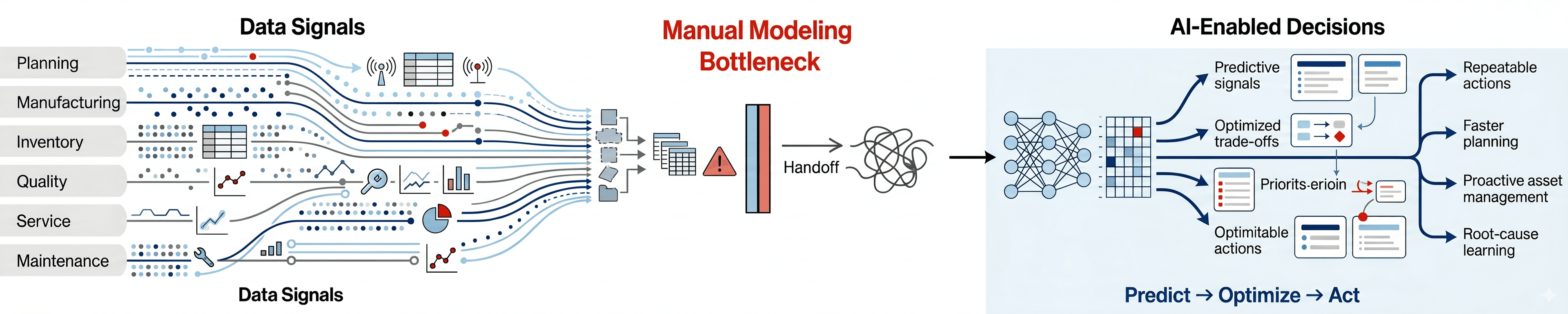
For CEOs & CMOs: You bought the warehouse, the dashboards, and the BI seats—and your team still argues about what to do next. That's not a tooling gap. Traditional business intelligence captured your transactions but never your collective intelligence: the judgment, context, and know-how distributed across your people. This article explains why BI stalled and how a modern approach turns scattered data and human insight into faster, better decisions at scale.
Key takeaways
- Traditional BI captured data, not intelligence. It recorded what happened; it never captured the reasoning, context, and expertise your people use to decide what to do about it.
- Dashboards are inputs, not decisions. A screen full of green and red numbers still leaves the hardest question—so what do we do?—to a meeting and a hunch.
- Collective intelligence is your real asset. The most valuable knowledge in your company lives in the heads of your best salesperson, your ops lead, and your CFO—and BI has no place to put it.
- A modern approach fuses data with human judgment and AI synthesis, then delivers the answer at the moment of the decision—so the whole organization decides faster and better, not just the analytics team.
BI promised decisions and delivered dashboards
The pitch for business intelligence was always about decisions. Centralize the data, put it in front of leaders, and the organization would decide faster and with more confidence.
Two decades and untold millions in licenses later, most companies have the dashboards and not the decisions. The data warehouse is full. The BI tool is deployed. And when leadership asks "what should we do differently this quarter?", the room still goes quiet—or worse, defers to whoever speaks with the most conviction.
That's not a failure of effort or budget. It's a failure of design. Business intelligence was built to answer one question—what happened?—and it answers it beautifully. But that was never the question that moved the business.
What BI actually captured—and what it missed
Here's the uncomfortable truth: traditional BI captured your transactions, not your intelligence.
Every system of record—your CRM, your finance stack, your ad platforms, your ERP—logs events. A deal closed. A campaign spent. An invoice cleared. BI aggregates those events into dashboards. That's genuinely useful, and it's also a fraction of what your organization actually knows.
Because the intelligence that runs your business doesn't live in the tables. It lives in your people:
| Where the data lives | Where the intelligence lives |
|---|---|
| The CRM shows a deal was lost | Your rep knows why—the champion left, the budget froze, the competitor undercut on terms |
| The dashboard shows CPL rose 15% | Your marketer knows a seasonal competitor just entered the auction |
| The P&L shows margin slipped | Your ops lead knows a single supplier renegotiated last month |
| Churn ticked up in the report | Support knows three enterprise accounts hit the same onboarding wall |
BI captured the left column and threw the right column away. The context, the causation, the hard-won judgment—the collective intelligence of the organization—had nowhere to go. It stayed trapped in hallway conversations, Slack threads, and the memory of your most experienced people. And when those people were busy, on vacation, or gone, the intelligence went with them.
A dashboard that shows what without why isn't intelligence. It's a scoreboard.
A pattern I saw everywhere
Across two decades of marketing and sales leadership—coupled with data and analytics work at companies like UPS, Fidelity, USAA, TIAA, Humana, and GSK—I sat in the meetings where the dashboards were supposed to make the decision.
They almost never did.
The best decisions in those rooms came when someone combined the number on the screen with something the number couldn't show: a rep's read on a buyer, an analyst's memory of the last time this pattern appeared, a leader's sense of where the market was heading. The data set the stage. The collective intelligence in the room made the call.
And that was the problem, because that intelligence only showed up when the right people happened to be in the right meeting. It didn't scale. It couldn't be queried. It never made it back into the system to inform the next decision. Every organization I worked in was, in effect, re-learning what it already knew—over and over—because it had a system for storing data and no system for capturing intelligence.
That gap is exactly what we built Digital Optimus to close.
Why the old model couldn't capture intelligence
It's worth being precise about why traditional BI missed the collective layer—because the reasons explain what a modern approach has to fix.
- It was built for structured data. Rows and columns can hold a revenue figure. They can't hold "the buyer went dark after the pricing change." So the most decision-relevant knowledge was, by architecture, out of scope.
- It centralized analysis in one team. Insight flowed up to a small analytics group and out as reports. The people closest to the customer—who held the context—were data sources, not participants.
- It was backward-looking by default. Dashboards explained the past. By the time a trend surfaced in a monthly readout, the moment to act on it had often passed.
- It stopped at the report. BI's job description ended when the chart rendered. The last mile—turning a chart into a decision an owner acts on this week—was left to meetings, politics, and gut.
Any one of these would blunt the payoff. Together, they guaranteed that "business intelligence" would produce a lot of business information and very little intelligence.
The modern approach: capture the collective, then activate it
A modern approach to business intelligence starts from a different premise. The goal isn't a prettier dashboard. It's to capture the organization's collective intelligence and put it to work at the point of every decision.
That means fusing three things traditional BI kept apart:
| Layer | What it contributes |
|---|---|
| Hard data | The objective record—what happened, across every system, in one connected view |
| Human judgment | The context and causation your people carry—captured, not lost to the hallway |
| AI synthesis | The connective tissue—reconciling the two, surfacing the pattern, and drafting the "so what" in minutes instead of weeks |
AI is what finally makes this practical. For the first time, the messy, unstructured, human side of your intelligence—notes, calls, comments, the reasons behind the numbers—can be captured and reconciled with the structured data at scale. The same technology can baseline your funnel, run a key driver analysis to separate the levers that move revenue from the ones that just move, and hand a decision-maker a recommendation with its reasoning attached.
The shift, side by side:
| Traditional BI | Modern (collective) intelligence | |
|---|---|---|
| Captures | Transactions and events | Transactions plus human context and judgment |
| Answers | "What happened?" | "What should we do, and why?" |
| Who's involved | A central analytics team | Everyone close to the decision |
| Timing | Backward-looking reports | Real-time, at the point of decision |
| Ends at | The dashboard | The decision an owner acts on |
| Scales | The volume of data | The quality and speed of decisions |
What this looks like in practice
Modern business intelligence isn't a bigger data project. It's a tighter loop between what you know and what you do:
- Connect the record. One view of the customer and the business across analytics, CRM, ads, and finance—so everyone argues from the same numbers, not five conflicting exports.
- Capture the context. Give the "why" a place to live. The reason a deal was lost, the pattern support keeps seeing, the market read from your best rep—captured alongside the data, not stranded in someone's inbox.
- Let AI do the synthesis. Reconcile the structured and the human, surface the drivers, and draft the recommendation—so insight arrives in hours, not in next month's deck.
- Deliver at the point of decision. Put the answer where the decision is made—in the meeting, the review, the moment budget moves—not in a portal someone visits quarterly.
- Feed the decision back in. Every choice and its outcome becomes intelligence the next decision inherits. The organization stops re-learning what it already knew and starts compounding it.
That last point is the whole game. Traditional BI treated each report as a fresh start. Collective intelligence compounds—every decision makes the next one sharper, and the advantage widens over time.
The bottom line
Business intelligence didn't fail because the data was wrong or the tools were weak. It failed because it captured the wrong thing—your transactions instead of your intelligence—and then stopped at the dashboard instead of the decision.
The organizations pulling ahead aren't the ones with the most dashboards. They're the ones that capture what their people actually know, fuse it with their data, and put the answer in front of whoever has to decide—faster than the competition can hold a meeting about it.
That's the modern approach to business intelligence. Not more information. Better, faster decisions—at scale.
This is what we do. Digital Optimus helps companies turn scattered data and undocumented know-how into a system that drives faster, better decisions across the whole organization. Our performance marketing audit connects your data, surfaces your real drivers, and shows you where decisions are being made on hunches instead of intelligence. If you'd like to see what modern business intelligence looks like for your business, book a discovery call.
#BusinessIntelligence #CollectiveIntelligence #DataStrategy #AIStrategy #DataDrivenDecisions #Analytics #Leadership #DigitalTransformation